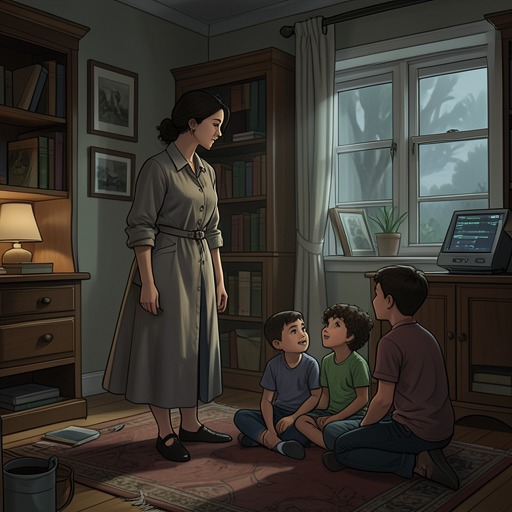
Oliver and Ann begin an affair
The War of the RosesOliver and Ann begin an affair while Oliver and Barbara are still sharing a house during their separation. Its first decisive crossing occurs in the library on Christmas Eve: an exchange of comfort becomes a kiss and an interrupted sexual encounter, followed by concealment and apology. What follows is not simply a sudden romance. Ann’s long-held desire meets Oliver’s distress, while both remain inside a family whose routines and children are being reshaped by the separation.
Background: Desire in a Divided Household
Ann’s feelings for Oliver predate their first kiss. She knows that her love is unrequited, and the conflict between Oliver and Barbara has made her an observer of the household as well as its caregiver. She studies movements, glances, and stray words for signs of what might happen, then reviews those details at night. Her self-imposed distance is difficult to maintain: curiosity seethes beneath her pose of indifference, and she worries that Oliver might see her as an alternative to Barbara. That possibility also produces guilt.
The children’s response makes the household conflict impossible for Ann to treat as a private matter between the spouses. At first, they try to bring their parents back together, but their efforts fade in the face of persistent hostility. Eve becomes increasingly absorbed in her friends, while Josh finds an equilibrium in sports and continues to see his father. Eve later tells Ann that she is afraid to leave her parents alone, and asks her to keep that fear secret. Ann’s growing intimacy with Oliver thus develops alongside her responsibility to children who can see that their family is coming apart.
Ann’s guilt has an earlier source as well. When Eve explains that Barbara has declared her wish for independence and to pursue her own aspirations, Ann already knows what has happened between the parents, but the reality has not fully sunk in. She feels the impact of her own involvement and continues, outwardly, to deny it. The secret she carries is therefore not only romantic: it is bound to the family rupture she witnesses and to the difference between what she knows and what she can acknowledge.
Christmas Eve: The First Crossing
On Christmas Eve, Ann is in the library beside the decorated tree, with wrapped presents beneath it. Barbara and Oliver are not planning to exchange gifts, though each has bought something for Ann. The tree lights flicker and lose their brightness as Oliver enters; he pours himself a heavy scotch and raises a glass to better Christmases. When he says that Christmas is only for the children, his lips tremble and he cannot continue. Ann puts a hand on his arm, and he presses his hand against hers without turning.
Oliver describes himself as unable to find relief from the nightmare of the separation. Ann, for once, resists her usual caution. She turns toward him, and they kiss. The encounter becomes physically charged, fulfilling a particular fantasy Ann has carried: her fingers in Oliver’s wavy, salt-and-pepper hair. The scene’s movement is from watching to participation, from the controlled distance of Ann’s observer role to a bodily intimacy that neither of them can keep abstract.
The moment ends abruptly when the front door opens. Ann straightens her clothes and busies herself with the gifts; Oliver slips behind the armoire, just outside her view. Barbara enters and asks Ann about the pastry meat loaves she is preparing. Ann answers while trying not to reveal the tension in the room. After Barbara goes upstairs, Oliver emerges, whispers an apology, and withdraws his hand when Ann kisses its palm. He then leaves by the front door and goes upstairs, making it appear that he has only just arrived. Ann stays kneeling before the tree for a long time, wondering whether Barbara saw them, but refusing to let that possibility displace her happiness. The tree’s weak lights, which Ann had meant to ask Oliver to fix, remain flickering.
From Secrecy to Intimacy
When Barbara later takes the children to Boston, Massachusetts, Ann helps them pack and writes down Barbara’s extensive instructions for shopping and defrosting. She has also promised to feed Mercedes. Ann embraces the departing family at the door, but once the taxi has left she is privately elated at the prospect of being alone with Oliver. Her hope persists despite his lack of encouragement, especially after his apology for the Christmas Eve encounter. She prepares herself carefully, measuring her own appearance against Barbara’s and remembering that nothing has affected her as powerfully as that brief moment with Oliver.
Their intimacy deepens when Oliver speaks of anger and self-reproach. He is furious with Barbara, with the people advising them, and with himself; he says his ego has died. Ann comforts him, embracing and kissing his hair as he weeps. The scene places tenderness beside vulnerability: Oliver’s body shakes with sobs, and Ann’s response is both solicitous and passionate. After they make love, he thanks her. He then leads her to his room, which she has not entered since he moved into it. Dust, scattered files and papers, unwashed dishes, and half-filled liquor bottles make the room a visible contrast to the shared household. Oliver points out a Staffordshire figure of Queen Victoria, a forgery he keeps as a reminder that he was cheated in Atlantic City. The object gives physical form to his account of himself as someone who has been deceived.
A later encounter has a different rhythm. Oliver admits that he does not know how to trust what a woman says or shows him, because he had misunderstood Barbara for years. Ann answers that women are conditioned to keep secrets, and Oliver counters that men are too. They then make love slowly and tenderly; this time Oliver does not break away, and afterward they lie beside one another with their fingers locked. The change from the hurried, interrupted kiss on Christmas Eve to this sustained closeness marks the affair’s development, though it does not resolve the pain or distrust that surround it.
The Affair Within the Family Conflict
The house remains central even in the lovers’ private conversation. Ann asks Oliver why he fights for it when the family has already been divided, and suggests that the house and its possessions are only things. Oliver rejects that separation: to him, the house is his whole world, and surrendering it would mean letting Barbara take that world with her. He says he is willing to give her half its value, but stresses his own labor and effort in acquiring it. Their exchange shows that the affair does not draw Oliver away from the contest with Barbara; even in intimacy, the house dispute occupies the space between them.
Ann’s position is therefore divided. She is Oliver’s lover, but she remains connected to Barbara and the children through her work in the household. She observes the parents’ hostility, manages practical tasks, and becomes the person to whom Eve confides her fear that something may happen if the parents are left alone. Much later, when Eve panics because neither parent has called or written, Ann promises to find them and insist that they contact their children. Her attempt to protect Eve also requires keeping the children away from the dangerous house. These responsibilities do not erase Ann’s secret relationship with Oliver; they place it inside a continuing family crisis.
The affair’s significance lies in that collision. Ann’s desire is not detached from the separation: it takes shape through watching Oliver’s hurt, answering his need for comfort, and concealing their contact from Barbara. The first kiss is interrupted by the household’s return, and later intimacy unfolds without removing the conflict over the house or restoring the family. Christmas lights that fail to shine, a concealed man behind an armoire, and fingers locked together after lovemaking give the relationship its recurring contrasts: exposure and concealment, distress and tenderness, private attachment and a family still living under one roof.